Mettler Toledo Authorised Distributor

Components & spares

Load Cells and Weighing Indicators in Ghana

Diagnosis, matched replacements and recalibration for weighbridges, platform scales and tank systems - with the fast-moving parts held in Tema so a failure is measured in days, not shipping weeks.

The cell gets blamed. The junction box is often guilty.

A weighing system is a chain: four to ten load cells, a junction box that sums their signals, a length of shielded cable, and an indicator that turns millivolts into a number. When the number goes wrong, the cells get replaced first because they are the part everyone has heard of. On a good share of the call-outs we attend in Ghana, the cells were fine and the fault was water in the junction box, a chewed cable, a corroded terminal or a surge-damaged indicator.

That matters commercially. A set of weighbridge cells is a serious purchase; a junction box gasket is not. Diagnosing properly before ordering is the difference between a repair that costs a part and one that costs a system.

Below is how our engineers narrow it down, what separates the main cell types, and why moisture and lightning are the two failure modes that dominate here.

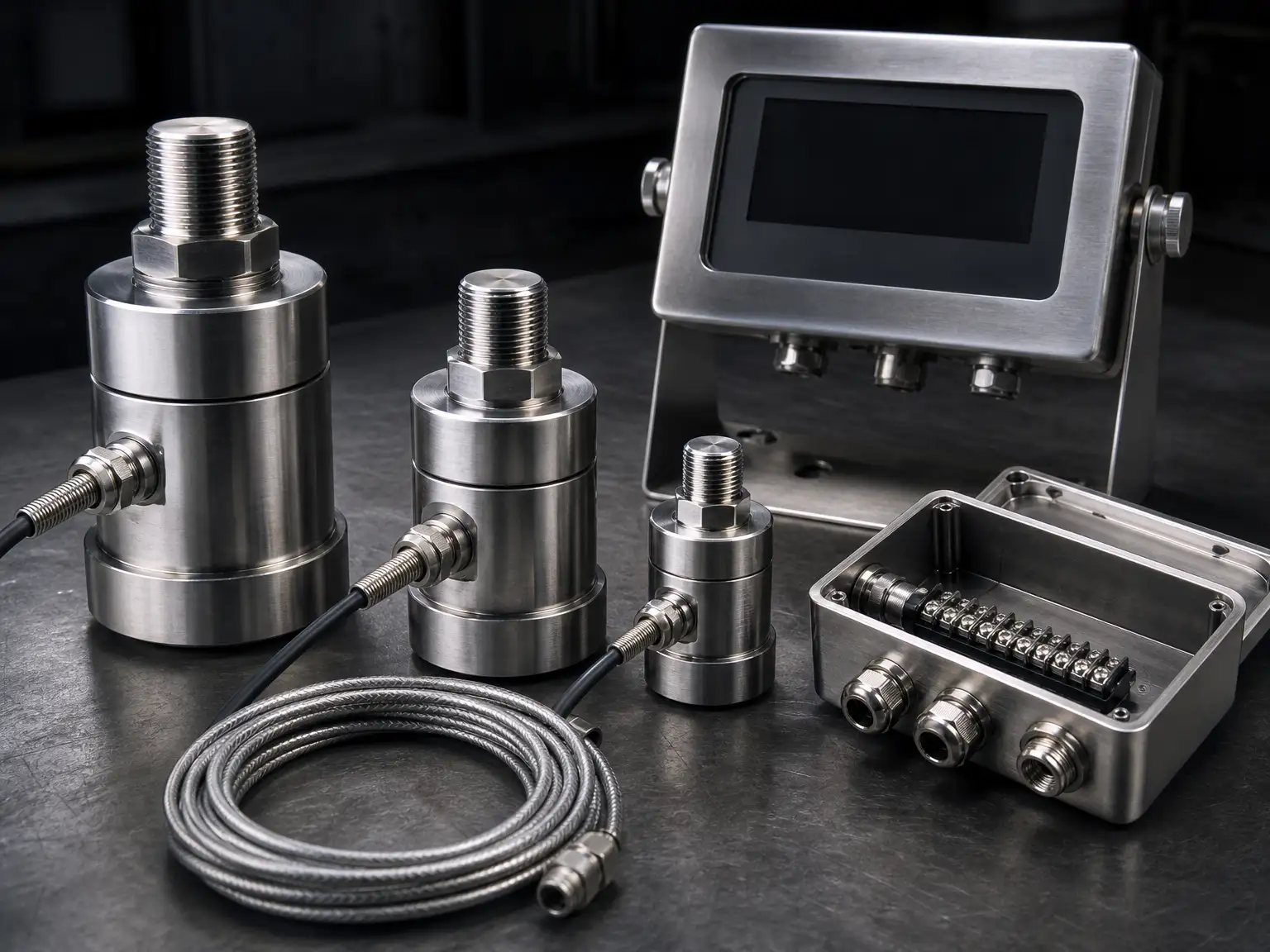
Stainless steel compression load cells, a junction box and a weight indicator laid out on a workshop bench

Fault finding

Cell, junction box, cable or indicator?

Work through these before you order a part. Each symptom points somewhere specific, and your operators can check most of them without tools.

Reading drifts upward or downward with nothing on the deck

Moisture in one load cell or in the junction box

Open the junction box and look for green corrosion on the terminals or water in the base. A cell that reads a steadily climbing zero after rain is almost always taking in water through a damaged cable gland.

Weight is correct in one spot and wrong in another

One failed or unevenly loaded cell

Walk a known weight across each cell position in turn. A cell that reads low only over its own corner has either failed or lost its mount - not an indicator fault.

Display jumps, flickers or will not settle

Cable damage, a loose terminal or electrical noise

Look for rodent damage and crush points where the cable enters the deck, and check that the shield is earthed at one end only. Noise from a nearby welder or VFD produces exactly this symptom.

Error code or no reading at all after a storm

Surge damage to the indicator or a cell

Isolate and measure each cell separately. Lightning season claims indicators and cells in roughly equal numbers, and the surge protector should be inspected at the same time.

Scale weighs light or heavy by a consistent percentage

Calibration drift, not a component failure

Check with certified test weights before replacing anything. A uniform error across the whole deck is a calibration job, and swapping parts will not fix it.

If the fault is on a truck scale, ourweighbridge maintenance and breakdown service covers the full diagnosis, and every repair ends witha recalibration against certified test weights.

Cell types

Compression, shear beam and single point

Three constructions cover nearly everything installed in Ghanaian industry. Which one you have is decided by how the load reaches the cell, not by the brand on the housing.

Compression cells

Rocker-pin or column cells that take the load straight down through their own axis. Used under weighbridge decks, silos, tanks and hoppers, typically from 10 t to 50 t each. The rocker design lets the deck self-centre after every truck, which is what keeps repeatability alive under constant traffic.

Typically found in

Weighbridges, silos, tanks, hoppers

Shear beam cells

A beam bolted down at one end with the load applied at the other, measuring shear rather than bending. The standard choice for platform and floor scales from a few hundred kilograms to several tonnes, usually four cells to a deck through a junction box.

Typically found in

Platform scales, floor scales, tank frames

Single point cells

One cell carries the whole platform and corrects for off-centre loading by itself, which is why a bench scale reads the same wherever you put the item on the pan. Found in bench, counter, retail and checkweighing scales up to around 300 kg.

Typically found in

Bench, counter, retail and packing scales

Capacities, protection ratings and indicator options are listed on theload cells, indicators and spares product page.

Why cells fail here

Lightning and moisture, in that order

Ghana sits in one of the more electrically active parts of the world, and a weighbridge is effectively a long metal aerial wired into a control room. A strike does not have to hit the deck: an induced surge in the signal cable is enough to destroy the amplifier in an indicator or punch through a cell's internal bridge. Proper earthing, a surge protection device on the junction box and protection on the indicator's mains supply are the cheapest insurance in the whole installation, and we fit them as standard.

Moisture is slower and, over a full year, more expensive. Pit weighbridges with a blocked sump sit in standing water through the rains. Wash-down rooms drive water at pressure into cable entries. On the coast at Tema and Takoradi, salt air corrodes glands and terminals from the outside in. Water inside a cell shows up first as a zero that will not stay put, then as a scale that reads high on one corner, then as no signal at all.

Three habits prevent most of it: keep pit drainage clear and test it before the rains, replace cable glands and gaskets when they harden rather than after they leak, and specify IP68 cells with stainless junction boxes anywhere near salt or water. Unstable grid power adds a fourth - an indicator on a conditioned supply survives the switching surges around an outage far better than one plugged straight into the wall.

Matching a replacement to an existing system

A replacement cell has to match on four things: rated capacity, rated output in mV/V, cable length, and mechanical fit including thread, mounting kit and body height. Capacity and output are the two that get missed. Fit a 30 t cell where the others are 20 t and that corner reads low on every truck; mix a 2 mV/V cell into a 3 mV/V set and the corner trims will never balance.

Cable length matters more than people expect, because the cable is part of the calibrated signal path. Cutting a cell's cable to tidy an installation changes its output. Always run the full length back to the junction box and coil the excess.

Mixing brands within one deck is possible but rarely worth it. The summing card, the corner adjustment range and the indicator's excitation all assume a matched set, and the time an engineer spends balancing a mismatched deck usually exceeds the saving on the part.

Send us the make, capacity, cell type and a photo of the data plate and we will confirm a genuine match, or state plainly where a compatible alternative is the sensible answer.

Why spares in Tema shorten downtime

The repair itself is short. Lifting a deck corner, swapping a cell and recalibrating is a day's work. What turns a day into six weeks is waiting for a part to clear a shipment and then the port.

For a quarry, a cement depot or a cocoa buying station in season, that wait is not an inconvenience - it is trucks weighed on a neighbour's bridge, or worse, sold on estimate. Holding the fast-moving items in Community 10 is a deliberate answer to that: it is why our own service calls end with a working scale far more often than with a quotation for an import.

If your operation cannot afford downtime at all, the stronger move is one spare cell and one spare indicator on your own shelf, bought with the system and matched to it. We advise which items are worth stocking based on what actually fails on your equipment.

Indicators, junction boxes, surge protection and cable

We supply the rest of the chain as well: panel, desk, column and weatherproof indicators with printer and PC output; stainless summing boxes with corner trim and surge protection; earthing kits; and shielded four- or six-core weighing cable by the metre, so a damaged run gets replaced properly instead of joined in a terminal block.

FAQ

Common questions about load cells and indicators

How do I know it is the load cell and not the indicator?

Symptoms that follow a position on the deck point to a cell; symptoms that are the same everywhere point to the indicator, the cable or the calibration. An engineer confirms it by disconnecting the cells at the junction box and reading each one individually - about twenty minutes of work that saves buying the wrong part.

Can I replace one cell, or must I change the whole set?

One cell is usually fine if the others are healthy and the replacement matches capacity, output and cable length. Where several cells have already been in service for many years in wet or coastal conditions, replacing the set costs less than three separate call-outs over the following year.

Do you supply load cells for equipment you did not install?

Yes, and a large share of our parts work is exactly that. Send a photo of the load cell data plate, the junction box interior and the indicator model, and we will confirm what fits before you commit to anything.

How long does a replacement take?

Where the part is in our Tema store, most single-cell jobs are done in one visit including recalibration. Anything that has to be imported is measured in weeks, which is the whole argument for holding a spare cell on site.

Does the scale need recalibration after a cell is changed?

Always. A new cell has its own output characteristics, and fitting it without recalibrating simply moves the error somewhere else on the deck. We recalibrate with certified test weights and issue the certificate as part of the job.

Send us the data plate. We will tell you what fits.

Photograph the load cell label, the junction box and the indicator, and we will confirm the replacement, what it costs and whether it is on our shelf in Tema.