
Calibration services
Scale and Weighbridge Calibration in Ghana
Certified test weights, a full corner and repeatability test, and a signed certificate that stands up when a customer, an auditor or a tax officer questions your tonnage.
What a calibration proves, and what it does not
On most industrial sites in Ghana the weighbridge is the cash register. Clinker leaving a plant, manganese running down to Takoradi, quarry product through a gate, cocoa arriving at a buying centre, waste tipped at a transfer station - each becomes an invoice line because an instrument produced a number. Calibration is what establishes, in writing, how far that number sat from true mass on the day it was tested.
The work itself is a comparison. Known masses, traceable to national standards through their own certificates, are applied to the instrument and the deviation is recorded at each test point. It does not make a scale accurate. It tells you, in numbers you can hand to somebody else, whether it is - and by how much it is not.
That matters most in the gap between a mine, a plant or a farm gate and the port. When a consignment leaves at one weight and arrives at another, somebody absorbs the difference. Without a current record at each end, the argument is settled by whoever shouts loudest rather than by evidence.
Calibration is not the same as verification or stamping
Instruments used for trade in Ghana fall under legal metrology, and the Ghana Standards Authority verifies and marks equipment used to buy and sell by weight. That is a legal act performed by the regulator on a cycle, ending in a stamp or seal that says the instrument was found fit for trade use at that moment.
A calibration is your own technical evidence, produced as often as your risk justifies rather than as often as the law requires. The verification keeps you compliant. The calibration record in between is what you produce in March when the dispute is live, the last stamp is from November, and your customer wants to know what the bridge was doing on the day their truck loaded. Keeping the instrument in order between verifications also makes the regulator visit a formality rather than a risk.
Intervals
How often equipment should be calibrated
There is no single correct interval. The right one is set by how hard the instrument works, what it costs you to be wrong, and what the environment does to it between visits.
- Truck weighbridges
- Every six months as a baseline, quarterly where the bridge sees heavy daily traffic, tipper wheels and standing water. A bridge weighing forty trucks a day is a different machine from one weighing four.
- Platform & floor scales
- Annually for light warehouse duty, twice a year where the scale is washed down, moved between rooms, or used to bill a customer directly.
- Bench, counting & retail scales
- Annually, with a short in-house check against a certified weight each week. These are the instruments most often knocked, unplugged and carried to another bench.
- Laboratory balances
- Every three to six months depending on how tight your method is, on top of the internal calibration the balance runs itself and a daily check weight logged by the analyst.
What pulls a calibration forward
- Any repair - a replaced load cell, junction box, cable run or indicator changes the system, so the old certificate no longer describes it
- Relocation, re-levelling or new foundation work under a deck
- A lightning event or a power surge that took the terminal down
- Harmattan, when dust packs into deck gaps and under check rods, and the end of the rains, when a foundation may have settled or a pit has held water
- A customer dispute, a supplier dispute, or an internal stock variance you cannot explain
On site
How a weighbridge calibration is actually performed
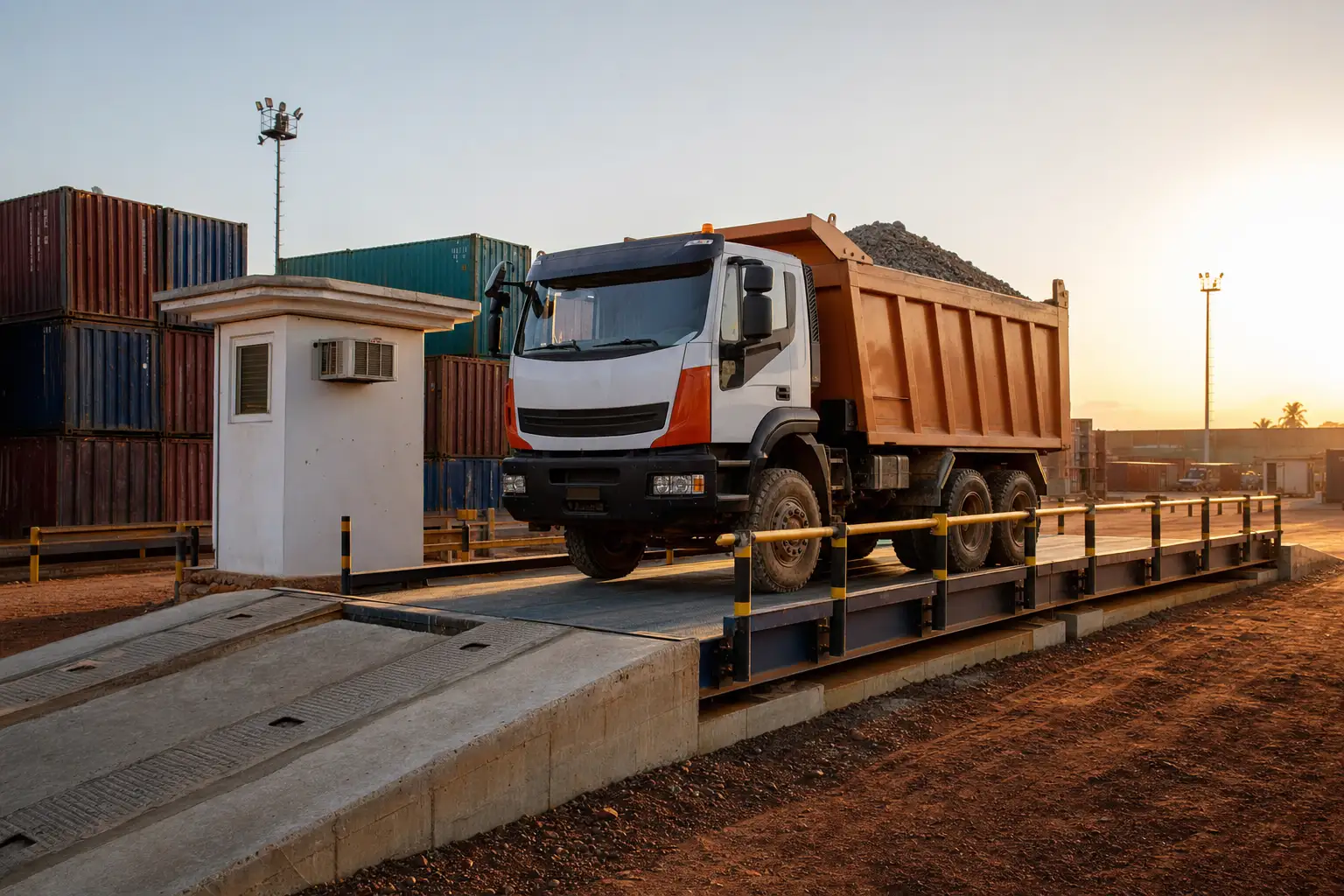
A calibration that only records a few readings at zero and full load tells you very little. This is the sequence our engineers work through, and it is why a bridge is normally out of service for a few hours rather than a few minutes.
- 01
Inspection before a single weight is loaded
Deck clearances, debris and stone under the platform, check rods, rocker pin seating, drainage, cable condition and moisture in the junction box. A calibration performed on top of a mechanical fault only records the fault.
- 02
Zero, warm-up and stability
The terminal is left powered and stable, the empty deck zero is recorded as found, and the reading is watched for drift before any test load is applied.
- 03
Build-up test with certified weights
Certified cast iron blocks are loaded in steps up the working range. Because nobody carries sixty tonnes of blocks to a yard, the build-up method uses the certified weights to qualify a substitution load, then repeats in steps to full capacity.
- 04
Corner and eccentricity checks
The same load is read over each load cell position in turn. Differences between corners are how a settled mount, a fouled deck or a drifting cell reveals itself long before the total reading looks wrong.
- 05
Repeatability and return to zero
The same load is driven on and off several times, from both approach directions, and the spread of the readings is recorded along with how cleanly the bridge returns to zero.
- 06
Adjustment, seal and a live truck
Where deviations sit outside tolerance the system is adjusted and the whole test repeated as-left. The terminal is sealed and a real loaded vehicle is weighed before the site goes back to commercial weighing.
What the certificate has to contain
A certificate is only worth what it states. Ours records the test in enough detail that a third party can judge it without having been there.
- Instrument identification: make, serial number, capacity and scale division, plus exactly where it stands
- Date, time and ambient conditions during the test
- The test weights used, their nominal values and the reference of their own traceable certificates
- Reading and deviation at every test point, as-found and as-left
- Eccentricity and repeatability results, not just a single linearity table
- The tolerance applied and a plain pass or fail statement against it
- The engineer who performed the work, signed, and the date the next calibration falls due
The people who ask to see it are predictable: your external auditor at year end, a customer challenging a delivery note, a buyer reconciling export tonnage against what the vessel received, and your own finance team when stock on paper does not match stock on the ground.
Out of tolerance
What happens when a scale fails
A failed calibration is not a disaster, and it is certainly not something to adjust away quietly. The as-found readings are recorded exactly as they were, because those numbers are the only honest record of what your instrument has been doing since the last visit. Adjust first and you destroy the evidence you may need.
The engineer then finds the cause rather than trimming the span to hide it. On weighbridges the usual suspects are a load cell that has drifted or taken a surge, water inside a junction box, stone compacted under the deck, a seized check rod after a heavy impact, or a foundation corner that has moved since the rains. On bench and floor scales it is more often a cell damaged by an overload, a knocked levelling foot, or an indicator that lost its settings during a power event.
Once the fault is corrected the full test is repeated and the as-left figures are certified. The last step is commercial: with the deviation quantified and the date of the last good certificate known, you can work out which consignments fall in the affected window and decide what to do about them before a customer raises it first. Parts come from our Tema stock, and every replacement is followed by a recalibration rather than just a parts swap - set out on ourinstallation, calibration and maintenance services page.
Questions we get
Calibration questions from Ghanaian sites
Do you really carry the full capacity in test weights?
No, and nobody sensibly does. Certified blocks are used to qualify a substitution load, which is then built up in steps to the working capacity of the bridge. The certified weights remain the reference at every stage. If you want to run your own checks between visits, we also supply certified test weights for in-house verification.
How long is the weighbridge out of service?
Plan for half a day on a typical truck scale, longer if a fault is found or the deck needs clearing first. Sites with a queue at the gate usually book us for early morning or a shift changeover so the disruption lands where it costs least.
Can you calibrate equipment you did not supply?
Yes. A large share of the instruments we calibrate were installed by somebody else, including older bridges and scales whose original supplier has left the market. Give us the make, capacity and indicator type and we will confirm before the visit.
Does unstable power affect weighing accuracy?
It does. Voltage dips, generator changeovers and lightning season all reach the terminal and the load cell wiring. Poor earthing shows up as a wandering zero long before it shows up as a dead cell, so earthing, surge protection and cable condition are checked as part of every visit. Keeping that under control is the point of aplanned weighbridge maintenance contract.
Can several sites sit on one schedule?
Yes - weighbridges, floor scales, bench scales and balances go on one calendar, with certificates issued per visit and a daily operator log kept in between. Start from the range on ourindustrial scales page and tell us what is installed where.
Put your calibration on a schedule you can defend.
Send us a list of the instruments on site and where they sit. We will come back with an interval for each one, a visit plan, and the certificates your auditors and customers will ask for.