
Automation & software
Weighbridge Automation and Software in Ghana
Shorter queues at the gate, tickets nobody can quietly edit, and month-end tonnage that reconciles without three people and a stack of carbon copies.
What automation actually removes
A weighbridge produces a number. Everything that happens after that number - writing it on a pad, reading it back to a driver, filing the carbon copy, keying it into a spreadsheet on Monday - is where the money leaks. Automation is not about the steel on the deck. It is about closing the distance between the reading and the invoice.
The first thing it removes is the handwritten ticket. Manual tickets go missing, get written in a hand nobody can read after a fortnight in a dusty cabin, and quietly acquire a different figure between the gate and accounts. A printed or electronic ticket carries the same record to the driver, to the customer and to finance, and keeps the original where it can still be found in June.
The second is queue time. A truck idling in a line at a plant gate costs the haulier and usually costs you, because that vehicle is on your account for the day. Most of the delay is not the weighing - it is the paperwork at the window, the search for the order, the argument about the tare. Stored tares and a card or tag at the terminal collapse a three minute stop into seconds.
The third is the space where weight fraud lives. Double weighing, re-runs after a partial tip, a tare captured with two men still in the cab, a ticket cancelled and rewritten with a friendlier figure - all of it depends on a transaction nobody records independently. Cameras at gross and tare, an audit trail on every edited or cancelled ticket, and identification tied to the vehicle make those routes visible rather than merely discouraged.
The fourth is month end. Where tickets are typed up after the fact, reconciliation means matching three imperfect records: the gate log, the delivery notes and the customer statement. When the weighing system owns the record and exports it, finance works from one dataset and spends its time on exceptions instead of arithmetic - which is also what makes shrinkage between a mine, a depot and the port measurable rather than assumed.
System parts
What a full system is made of
Very few sites need all of this on day one. Knowing the whole picture matters anyway, because the cabling, the power and the software licence you choose at the start decide how expensive the next stage will be. The equipment itself is described on ourweighbridge automation and software product page.
Weighing terminal and software
The terminal reads the bridge; the software turns the reading into a transaction - vehicle, product, customer, gross, tare, net, operator and timestamp - stored so it cannot be altered without leaving a trace.
Driver identification
RFID tags or cards, or a barcode on a delivery note, tie the truck to a stored tare and an open order. The driver stops being a name written down by hand and becomes a record the system already knows.
Barriers and traffic lights
Lights instruct the driver to advance, stop, or reverse to centre the axles; barriers stop a second vehicle rolling onto the deck mid-transaction, which is the most common cause of a nonsense reading.
Cameras and plate capture
Fixed cameras photograph the vehicle, the deck and the plate at gross and at tare. ANPR reads the plate and matches it to the record, so a ticket can be reconstructed months later with a picture attached.
Ticket printing and displays
A printer at the cabin or a self-service kiosk issues the ticket, and a large remote display shows the driver the weight being recorded rather than leaving them to trust it.
Reporting and system integration
Daily tonnage, per-customer and per-product summaries, and exports to Excel or into your existing ERP or accounting package, so finance stops keying weighbridge tickets by hand.
Staged adoption
Starting from a manual gate
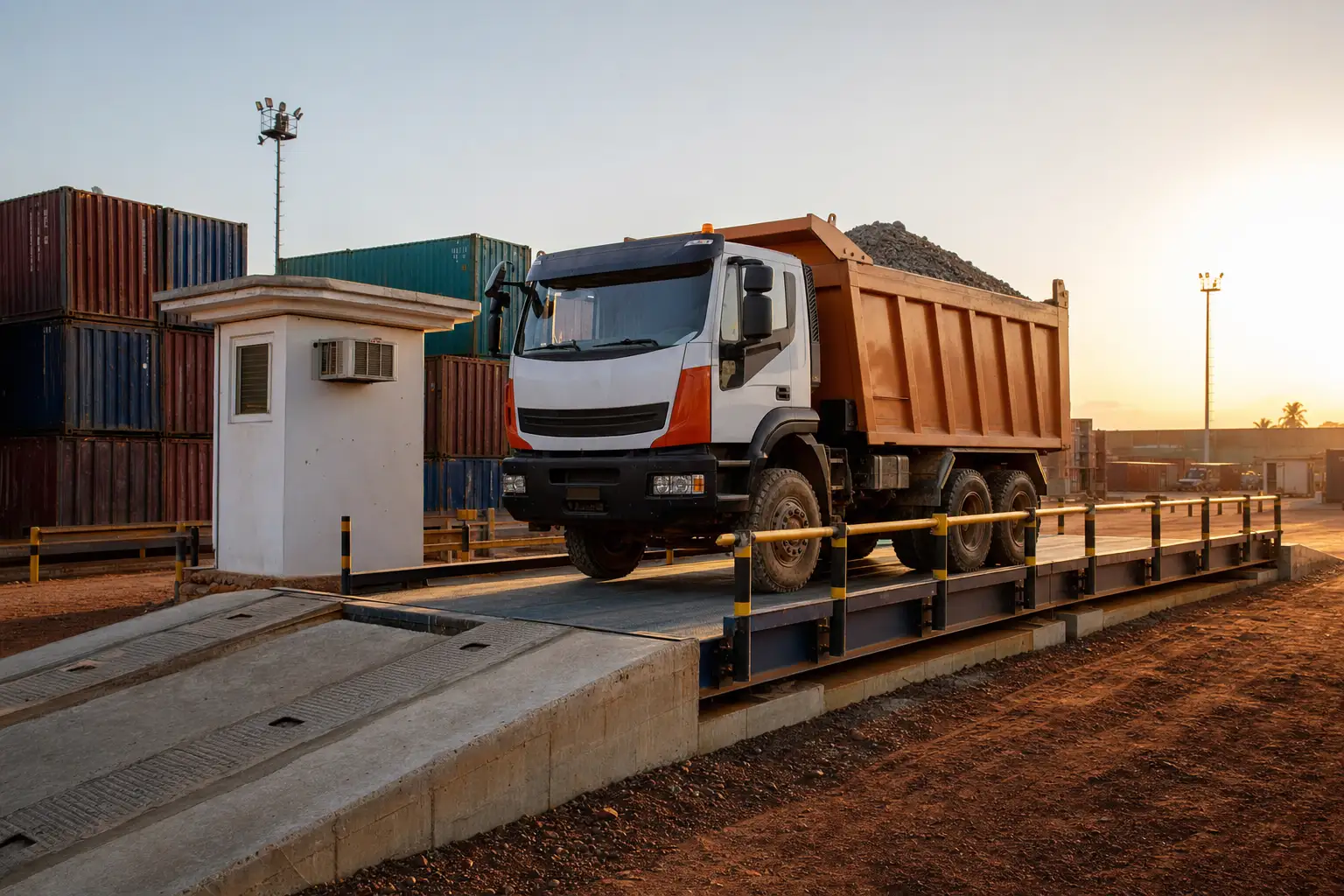
If your gate runs on a duplicate book and a clerk today, going straight to unattended weighing is usually the wrong move. Staging the work lets your team absorb one change at a time and lets the earlier stages fund the later ones.
- 01
Ticketing on the existing bridge
A PC in the cabin, the software connected to your current terminal, stored tares and printed tickets with your letterhead. Nothing on the deck changes, and the first month of clean data usually pays for the stage on its own.
- 02
Identification and evidence
RFID or barcode identification for regular vehicles, plus cameras on gross and tare. Transaction time at the window drops and the arguments about which truck weighed what end.
- 03
Controlled traffic
Traffic lights, boom barriers and loop or photocell detection so vehicles are sequenced onto the deck properly. This is the point at which one operator can run a busier gate calmly.
- 04
Unattended weighing
A weatherproof driver terminal at the deck lets identified vehicles weigh themselves outside office hours, at night, or during a shift changeover, with the whole sequence still under the software.
The one decision worth making early is the deck itself. Automation is unforgiving of a bridge that is mechanically tired, because an unattended transaction has no operator standing there to notice a reading that looks wrong. Where a site is replacing the bridge anyway, it is far cheaper to run the conduit for barriers, lights and cameras during the civil work than to cut it in afterwards - which is why theweighbridge options we install in Ghana are worth reviewing alongside the software.
Power & network
Designed for how sites in Ghana actually run
An automation system specified for a European distribution park will disappoint on a quarry road in the Eastern Region. The failures are never in the weighing - they are in power, earthing, connectivity and dust.
- UPS on the terminal, PC and barrier controller so a grid dip during a transaction cannot leave a half-written ticket
- Clean earthing and surge protection on load cell cabling, camera runs and the network - lightning season takes out more weighbridge electronics than anything else
- The database held on site, not only in a hosted service, so weighing continues when the link to the internet does not
- Generator changeover tested with the system running, not just with the lights on
- Wired links between the cabin, the deck and the barriers wherever the run allows, with sealed conduit against dust and water
- Cameras and terminals rated for harmattan dust, coastal humidity and direct afternoon sun on an unshaded gate
The principle behind all of it is that the gate keeps working when something else does not. A truck arriving at 21:00 with no mains supply and no internet should still weigh, still get a ticket, and still be in the report your finance controller opens the next morning. Systems that hold their data on site and synchronise when the link returns behave that way; systems that assume a permanent connection stop the queue instead.
Questions we get
Common questions before automating a gate
Do we have to replace our weighbridge?
Usually not. If the deck and load cells are sound and the terminal has a serial or Ethernet output, the software connects to what you already own. We check the bridge and recalibrate it before automating, because automating an inaccurate scale simply distributes the error faster.
Will it work with our accounting or ERP system?
Exports to Excel and CSV are standard, and direct integration is done case by case against whatever your finance team runs. The practical question is which direction the data flows: most sites want orders and customers pulled in, and completed tickets pushed back out.
Can drivers still weigh if the software fails?
Yes. The terminal keeps displaying and printing weights independently of the PC, so a fallback manual procedure always exists. We write that procedure with your team during commissioning rather than leaving it to be invented during the first incident.
How does the system stop ticket manipulation?
Operators log in individually, cancellations and edits are kept with the original values and the reason, camera images attach to the transaction, and reports show re-weighs and voids as exceptions instead of hiding them. Nothing is deleted; it is superseded and visible.
Is unattended weighing realistic with mixed hauliers?
It suits a known fleet on tags and suits one-off third-party vehicles less well, so most Ghanaian sites run both: regular trucks unattended, casual vehicles handled at the window as two routes through one gate.
Who trains our operators, and what happens afterwards?
We train gate operators and finance users on site during commissioning, and support continues from Tema. Automation, calibration and maintenance sit together on ourservices page, and most automated sites keep all three on one agreement.
Start with the stage that pays for itself.
Send us your daily vehicle count, the terminal you run, and what happens to a ticket after the driver leaves. We will propose a first stage, what it changes, and what it leaves for later.